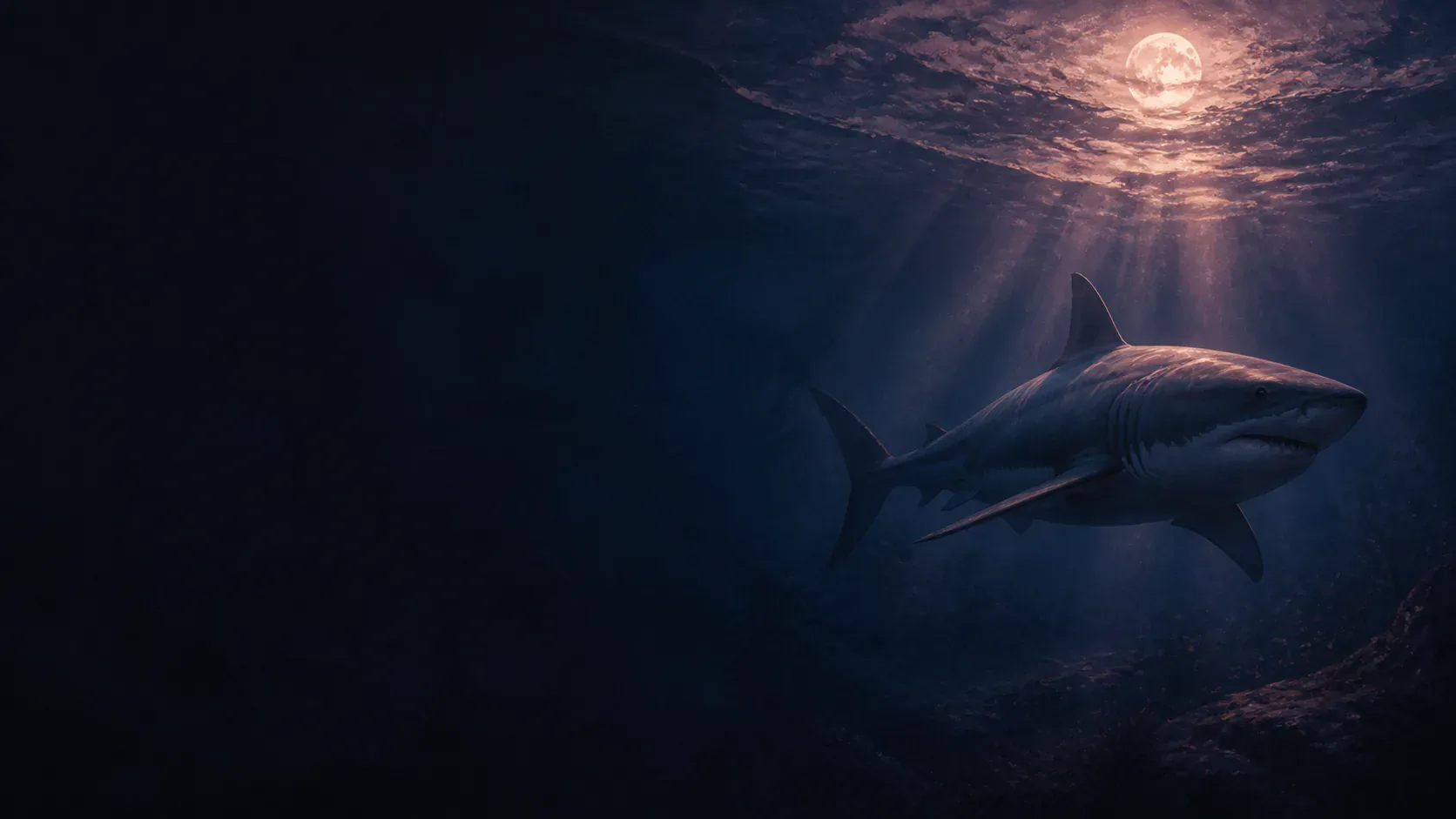
Dream symbol · Animals & threat perception
What Does Dreaming About a Shark Mean?
Explore a shark dream meaning through species, water, distance, movement, circling, feeding, pursuit, attack, boats, cages, and your response.
A short answer
A shark dream can focus on threat perception, exposure in water, pursuit, fascination, or the difficulty of judging distance and movement. Species, water conditions, the shark's actual behavior, your position, available exits, and the outcome matter more than a fixed meaning about enemies or betrayal.
What a shark dream can mean
A shark dream can bring threat perception, exposure in water, pursuit, fascination, or difficulty judging distance into focus. There is no proven meaning shared by every shark dream. Begin with the species or shape, water conditions, viewpoint, movement, available exits, and whether contact actually occurred.
A shark passing below a boat creates a different problem from one chasing you in dark water. A fin seen from shore leaves much of the animal unknown. A shark feeding on fish may ignore you completely. One trapped in a swimming pool turns the setting into an impossible enclosure.
Record the sequence before deciding the shark represents an enemy. Did it pass, circle, follow, feed, approach, strike, bite, become stranded, or disappear? Did you swim, freeze, climb out, enter a cage, warn someone, watch from safety, or wake before the distance closed?
Your history matters. The image may come from a real encounter, aquarium, documentary, game, film, news story, toy, sports logo, or fear learned long before the dream. Those sources shape expectation before the animal does anything.
Species shape and identification change expectation
Sharks vary enormously. A whale shark, hammerhead, nurse shark, great white, thresher, dogfish, and invented sea creature do not move or feed in the same way. You do not need a perfect species identification, but record the features that influenced you: head shape, tail, spots, size, teeth, dorsal fin, speed, or position near the seafloor.
NOAA Fisheries’ Sharpen Your Shark Facts describes wide variation in shark bodies, tails, reproduction, learning, and behavior. That diversity is a useful correction to the single movie image of a shark as an attacking fin.
Sometimes the dream never shows the whole animal. A shadow, fin, teeth, movement beneath a board, or warning from another person may be enough for everyone to say shark. Ask how the identification was made and whether it later changed.
A mistaken shark matters too. A dolphin, whale, ray, log, machine, or person may replace the first interpretation. The shift from assumed danger to a different object can be the central event.
Water depth visibility and enclosure set the conditions
Water controls how much you can see and how freely you can move. Clear shallow water gives you distance and direction. Dark deep water hides both. Waves, currents, ice, plants, debris, and artificial lighting change the encounter before the shark approaches.
Ask where the bottom, shore, surface, boat, ladder, or exit is. If none exists, exposure may come from the environment as much as the animal. If the water is only ankle-deep but the shark moves normally, the impossible scale may make escape or disbelief important.
Pools, aquariums, flooded rooms, streets, bathtubs, and tanks impose boundaries. Who put the shark there, and can it survive? An animal too large for its enclosure can shift concern from your safety to its condition.
The state of the water may come from a separate waking association. Muddy water, chlorinated water, a familiar beach, or a childhood pool deserves its own history rather than serving as a generic emotion symbol.
Passing circling feeding and approaching are distinct actions
A passing shark has a route that may not involve you. Which direction did it travel, and did it alter course? Relief after it passes can be real even when the animal never behaved aggressively.
Circling creates repetition and uncertain timing. How wide is the circle? Does it tighten, remain steady, include a boat or group, or continue after you leave the water? Circling is not the same as attacking, and the dream may center anticipation rather than contact.
Feeding changes attention. What is the shark eating, how close are you, and does the feeding draw it nearer or keep it occupied? A filter-feeding giant, a shark taking bait, and a chaotic feeding scene carry different risks under the dream’s rules.
Approach should be measured through change. Did the shark accelerate, drift, follow your movement, investigate an object, or appear closer each time you looked away? The gap between perceived intent and visible action is worth keeping.
Your position changes exposure and choice
Swimming puts you in the same medium as the shark. Can you move normally, breathe, see, or reach support? Are you alone, responsible for someone else, or following a guide? Your swimming ability and dream logic shape the options.
A boat provides separation but not necessarily calm. Is it stable, damaged, too small, moving, anchored, or overturned? Can you see the shark from above, and does anyone else believe you? A fin beside a boat differs from an animal striking it.
A cage creates a designed boundary. Are you inside voluntarily, locked in, protected, or trapped with the shark outside? Does the cage hold, open, sink, or become unnecessary when the animal ignores you?
From shore, an aircraft, bridge, screen, or aquarium tunnel, you may observe danger without sharing it. Ask whether you warn others, enjoy the view, record it, or feel guilty for remaining safe.
Pursuit attack and escape change the shark dream
Pursuit requires a route and changing distance. What triggered it? Did you enter the water, take food, separate from a group, make noise, or simply become the target without explanation? Dream logic can create pursuit without a realistic cause.
An attack should be remembered as a sequence. A charge, bump, strike, bite, collision, or damaged boat are different events. Where did contact occur, what did you feel, and what action followed? A bite does not predict injury, betrayal, illness, or a real attack.
Escape may involve reaching shore, climbing aboard, distracting the shark, hiding, waking, or discovering that you can breathe underwater. Did the escape depend on your action, another person, luck inside the scene, or the animal turning away?
If someone else is attacked, avoid treating the dream as a forecast about them. Focus on what you saw, what you could do, and how responsibility or helplessness worked in the scene.
Teeth injury and young animals alter the focus
Teeth may appear without an attack. A jaw in a museum, loose tooth, fossil, necklace, drawing, or impossible mouth carries different associations. If the dream isolates teeth, ask whether the animal itself is present.
An injured, caught, dead, or stranded shark can reverse the balance of power. Are you frightened, concerned, curious, responsible, or relieved? Did human activity cause the condition, and can anyone help? The dream may create an animal-care problem rather than a threat scene.
A young shark changes scale and expectation. Is it treated as harmless, kept as a pet, returned to water, growing rapidly, or followed by an adult? NOAA notes that shark reproduction and early life vary by species, so young sharks do not support one family or vulnerability formula.
If you are injured in the dream but continue moving, note the practical consequences. Blood, pain, reduced movement, and other sharks arriving may come from film language rather than real behavior.
Captive impossible and humanlike creatures need context
Aquarium sharks, trained animals, mechanical sharks, toys, cartoons, and humanlike figures draw from designed settings and stories. What rules govern the encounter? A shark performing for food is not the same as a wild animal approaching a swimmer.
A shark on land, in the sky, inside a building, or moving through walls makes escape and habitat impossible. Ask what remains sharklike: shape, teeth, movement, reputation, or the name given to it. The mismatch may matter more than species behavior.
If a person becomes a shark or wears a shark costume, do not treat the dream as proof of predatory intent. Record how and when the identity changes and what evidence exists inside the scene.
Talking sharks often come from media. The words can still connect to a waking concern, but the dream does not grant the animal special knowledge.
Films news and real encounters shape expectation
Shark dreams often borrow visual language from films, documentaries, aquarium tunnels, headlines, games, and social media. A familiar camera angle from below, musical cue, sudden fin, or impossible attack sequence may point directly to a media source.
Real ocean experience adds another layer. Swimming in open water, seeing a harmless fish, hearing a beach warning, taking a boat trip, or planning travel can supply water and distance even without a shark sighting.
Ask whether the dream matches what you know about sharks or what stories taught you to expect. The difference can explain why fear rises before any action occurs.
For real water safety or shark guidance, use current local authorities. Dream interpretation cannot assess an ocean condition, species, or attack risk.
Questions to ask after the encounter
Choose the questions that fit the remembered scene.
- What features made me identify the animal as a shark?
- How clear, deep, open, enclosed, or realistic was the water?
- Where was I in relation to shore, surface, boat, cage, and other people?
- Did the shark pass, circle, feed, follow, approach, strike, or make contact?
- What changed the distance, and what choices remained available?
- Did fear begin before visible danger, after a warning, or only after contact?
- Was the animal wild, captive, injured, young, dead, mechanical, or impossible?
- Which recent film, image, story, trip, aquarium, game, or water experience could have supplied the scene?
- How did it end, and what feeling remained after waking?
A useful reading should fit water, viewpoint, movement, distance, and outcome. An explanation based only on enemy or danger is too thin.
What research can explain about this kind of dream
Dream research does not provide a validated shark code. Research on continuity and non-continuity examines how waking concerns and memories can appear in dreams while also being transformed into scenes that do not mirror daily life.
You can reasonably notice that the dream organized attention around exposure, uncertainty, pursuit, fascination, or escape. You cannot infer that a shark proves someone will betray you, identifies a hidden enemy, predicts an attack, or diagnoses a fear disorder.
Check recent memory, older associations, the animal’s actual behavior, and your available choices. Sometimes the strongest explanation is a vivid piece of media or a real concern about water. Sometimes several sources combine.
Keep the interpretation that accounts for the most detail. Let the shark pass without turning it into a forecast when the scene gives you no reason to do more.
Further reading
Sources and context
- Sharpen Your Shark FactsNOAA Fisheries
- Reactions to Dream Content: Continuity and Non-continuityFrontiers in Psychology via PubMed Central
Sources support factual background about dreaming and sleep. They do not validate a fixed symbolic meaning.