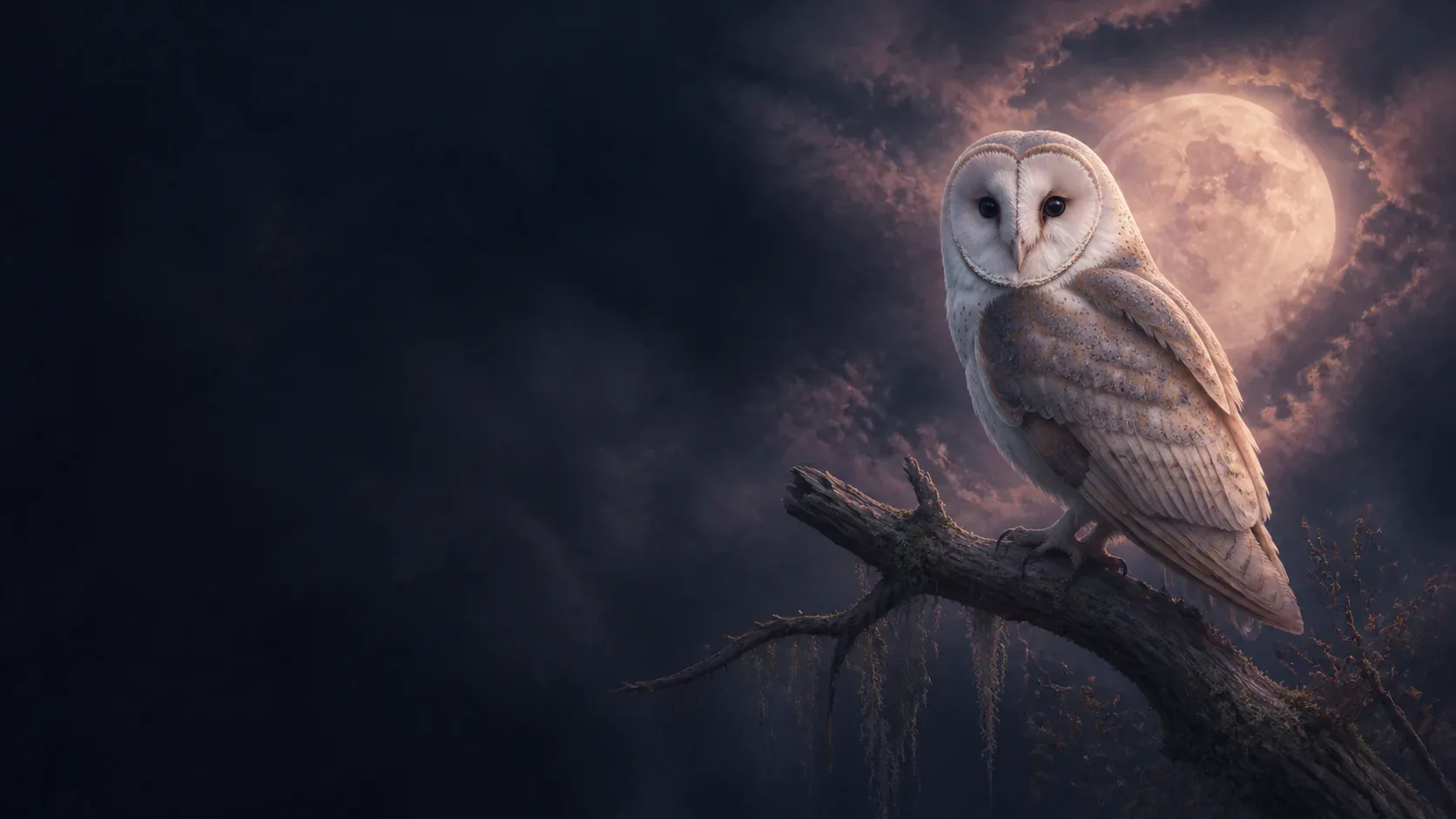
Dream symbol · Animals & attention
What Does Dreaming About an Owl Mean?
Explore an owl dream meaning through species cues, calls, silence, gaze, flight, hunting, darkness, enclosure, injury, and your response.
A short answer
An owl dream can focus on watching, being watched, hearing what you cannot see, quiet movement, hunting, or a striking nighttime encounter. The owl's behavior, species cues, sound, light, distance, and source in your own memories matter more than an omen or universal meaning about wisdom.
What an owl dream can mean
An owl dream can bring watching, being watched, hearing an unseen animal, quiet movement, hunting, or a nighttime encounter into focus. There is no proven meaning shared by every owl dream. Begin with what made the bird an owl, whether you saw or heard it first, the available light, its distance, and what it did.
An owl calling from outside creates a different problem from one staring across a bedroom. A bird passing silently overhead emphasizes movement. An owl carrying prey adds a completed hunt. An injured owl in your hands gives you responsibility and contact.
Record the sequence before using familiar ideas about wisdom. Did the bird perch, turn, call, follow, fly, hunt, strike, enter, become trapped, or leave? Did you watch, answer, hide, approach, release, rescue, or wake before the distance changed?
Your history matters. The owl may recall a real call at night, a zoo, a school emblem, a childhood book, a film, a decorative object, or a person associated with the bird. Those sources can shape the dream more directly than a broad cultural stereotype.
Species cues and light shape recognition
Owl covers many species with different sizes, habitats, calls, and activity patterns. You do not need to identify the species, but note the cues you used: ear-like tufts, facial disk, large eyes, pale heart-shaped face, small body, long legs, snowy color, or a deep hoot.
The Cornell Lab’s Great Horned Owl overview describes one large, tufted species with broad wings, strong nocturnal hunting habits, sensitive hearing, and varied habitat. It is a useful reference when the dream resembles that bird. It cannot stand for every owl.
Light changes what you can know. Moonlight may show a silhouette but hide color. A flashlight may reveal the bird suddenly. Daylight can make a nocturnal expectation feel unusual, although some real owls hunt during the day. Complete darkness may leave only sound and movement.
Ask how certain you were. A shape that becomes an owl when it turns its head differs from a bird named by someone else. Misidentification may be part of the dream rather than an error to correct.
Seeing and hearing create different encounters
An owl can be present through sound alone. Where did the call seem to come from? Did it remain fixed, move around you, echo, come through a wall, or sound impossibly close? Could everyone hear it, or only you?
If you saw the owl first, what drew your eye? It may have moved, contrasted with the background, occupied an expected perch, or appeared only after another animal reacted. Visual attention has a different rhythm from searching for an unseen caller.
Dream sound can also be invented. The owl may speak, repeat a name, imitate an alarm, sing, or make no sound despite opening its beak. Treat words as dream dialogue rather than supernatural information. Ask what the words connect to in your own memory.
Silence after repeated calls can mark departure, concealment, waiting, or your own loss of attention. Notice what happens next instead of assuming the silence carries a warning.
Perching gaze and head movement direct attention
A perched owl gives the scene a stable viewpoint. What could it see from the branch, roof, fence, sign, or shelf? Were you below, level with it, or looking down? The perch may explain why the bird remains still.
Being watched can feel intense because an owl’s face is visually striking. Did the bird track your movement, look past you, close its eyes, turn away, or hold its position while you approached? A gaze in a dream does not prove that another person is monitoring or judging you.
Head movement can redirect the scene. Perhaps the owl turns toward a sound you missed, rotates farther than expected, or points you toward another animal. Follow the chain of attention. What did you look at because the owl looked first?
Mutual observation can remain calm. If neither you nor the bird moves, ask whether the pause feels safe, respectful, tense, curious, or impossible to end. The feeling distinguishes quiet attention from threat.
Quiet flight changes distance quickly
Owls have physical adaptations that can make flight unusually quiet. In a dream, that quiet movement can reduce the warning before distance changes. Did the owl glide past, approach your face, land beside you, cross a road, or vanish into trees?
Direction matters. Flight away may end the encounter or invite pursuit. Flight toward you may feel threatening, welcome, or simply surprising. Circling overhead creates a different exposure from a bird moving on a straight route.
Listen for what replaces wing noise. Perhaps you hear air, a call, branches, your own footsteps, or nothing. An unnaturally loud owl can be just as important as a silent one because it breaks expectation.
The landing changes control. Where does the bird choose to settle, and can you move without disturbing it? An owl landing on your arm creates contact. One landing behind you may be known only through another person’s reaction.
Hunting prey and mobbing alter the role
Owls are predators, but hunting behavior varies by species and setting. A Great Horned Owl may watch from a perch and pursue prey across open habitat. Other owls rely heavily on hearing or hunt nearer the ground. Use only the behavior present in the dream.
Did the owl search, wait, dive, miss, catch, carry, or eat? Was the prey visible to you first? A completed hunt differs from endless scanning. If you protect the prey, interrupt the hunt, or become the target, your role changes the scene.
An owl carrying a mouse, rabbit, bird, fish, object, or impossible item needs precise description. The carried thing has its own associations. Do not reduce the whole scene to power or death.
Other birds sometimes mob owls. A noisy group of crows or songbirds surrounding a still owl creates collective pressure. Ask whether you side with the group, defend the owl, or watch without understanding the conflict.
Calls duets and repeated sounds need context
A single hoot, repeated pattern, duet, hiss, scream, or clicking sound creates different expectations. If two owls call, note whether they answer, overlap, approach, or remain far apart. The spacing may be more important than any imagined translation.
Calls can mark territory or communication in real birds, but a dream call is not a coded message for the dreamer. The scene may still help you reflect on who initiates contact, who responds, and whether sound makes location clearer or more uncertain.
If the call enters a phone, radio, recording, or human voice, the medium matters. Were you trying to identify it, prove it happened, replay it, or share it with someone who could not hear the same thing?
Repeated sound may also come from the waking environment. An alarm, bird outside, appliance, or person can be incorporated into a dream. Check ordinary sources before treating the repetition as significant.
An indoor injured or captive owl changes responsibility
An owl indoors creates a mismatch between animal and space. Which room contains it, how did it enter, and where can it leave? A warehouse, attic, classroom, bedroom, cage, and museum display give the bird different limits.
If you try to release it, note your method and knowledge. Do you open a window, carry the bird, call for help, or wait for it to choose a route? Does the owl cooperate, panic, attack, become tame, or refuse to leave?
An injured owl can center care with limited control. Record the injury without using it to predict loss. A held owl may feel heavy, calm, fragile, powerful, or impossible to contain. Your grip and fear of causing harm can be central.
Captivity adds ownership and permission. Who built the enclosure, who has the key, and what happens if the owl is released? For a real injured or trapped bird, use qualified local wildlife guidance rather than dream interpretation.
White giant and speaking owls come from expectation
A white owl may be a real pale species, seasonal image, character, decoration, or invention. A black, golden, red, mechanical, or transparent owl can draw from art and dream lighting. No color provides a universal omen.
A giant owl changes scale and power. Can it fit in the setting? Does its size make observation easier, escape harder, or the whole environment feel miniature? A tiny owl creates a different responsibility and may resemble a toy or ornament.
Speaking owls often come from stories in which the bird has an assigned role. Identify the book, film, game, logo, or school association when possible. A known character should be read through that history rather than a generic wildlife meaning.
If the owl gives advice, ask whether the words resemble your own concerns or something recently heard. The dream cannot verify the advice or give the speaker special authority.
Questions to ask after the encounter
Choose the questions that match your dream.
- What made me identify the bird as an owl?
- Did I hear it, see it, or notice another animal’s reaction first?
- How much light was available, and what remained hidden?
- Where was the owl perched, and what direction held its attention?
- Did flight change distance before I could respond?
- Was it calling, silent, hunting, carrying, mobbed, trapped, injured, or calm?
- What role did I take when the owl entered a private or enclosed space?
- Which recent sound, bird, story, image, emblem, or nighttime event could have supplied the scene?
- How did the encounter end, and what feeling stayed after waking?
A useful reading should fit sound, light, distance, behavior, and your response. A conclusion based only on wisdom or warning is too broad.
How waking memory enters owl dreams
Dream research does not provide a validated owl dictionary. Work on continuity and non-continuity in dreams supports checking waking experiences and emotions while recognizing that dreams recombine them in unusual ways.
Recent sources might include a bird call, nighttime walk, film, book, decorative object, wildlife video, school symbol, or news image. A real sound during sleep can also become part of the scene. Older memories may change the species, setting, and emotional tone.
You can reasonably say that the dream concentrated attention on an unseen sound, gaze, quiet approach, hunt, boundary, or care task. You cannot conclude that the owl predicts death, proves psychic knowledge, diagnoses fear, or delivers a universal spiritual message.
Keep the reading that best accounts for the actual action and your own context. Leave the rest open.
Further reading
Sources and context
- Great Horned Owl OverviewCornell Lab of Ornithology
- Reactions to Dream Content: Continuity and Non-continuityFrontiers in Psychology via PubMed Central
Sources support factual background about dreaming and sleep. They do not validate a fixed symbolic meaning.