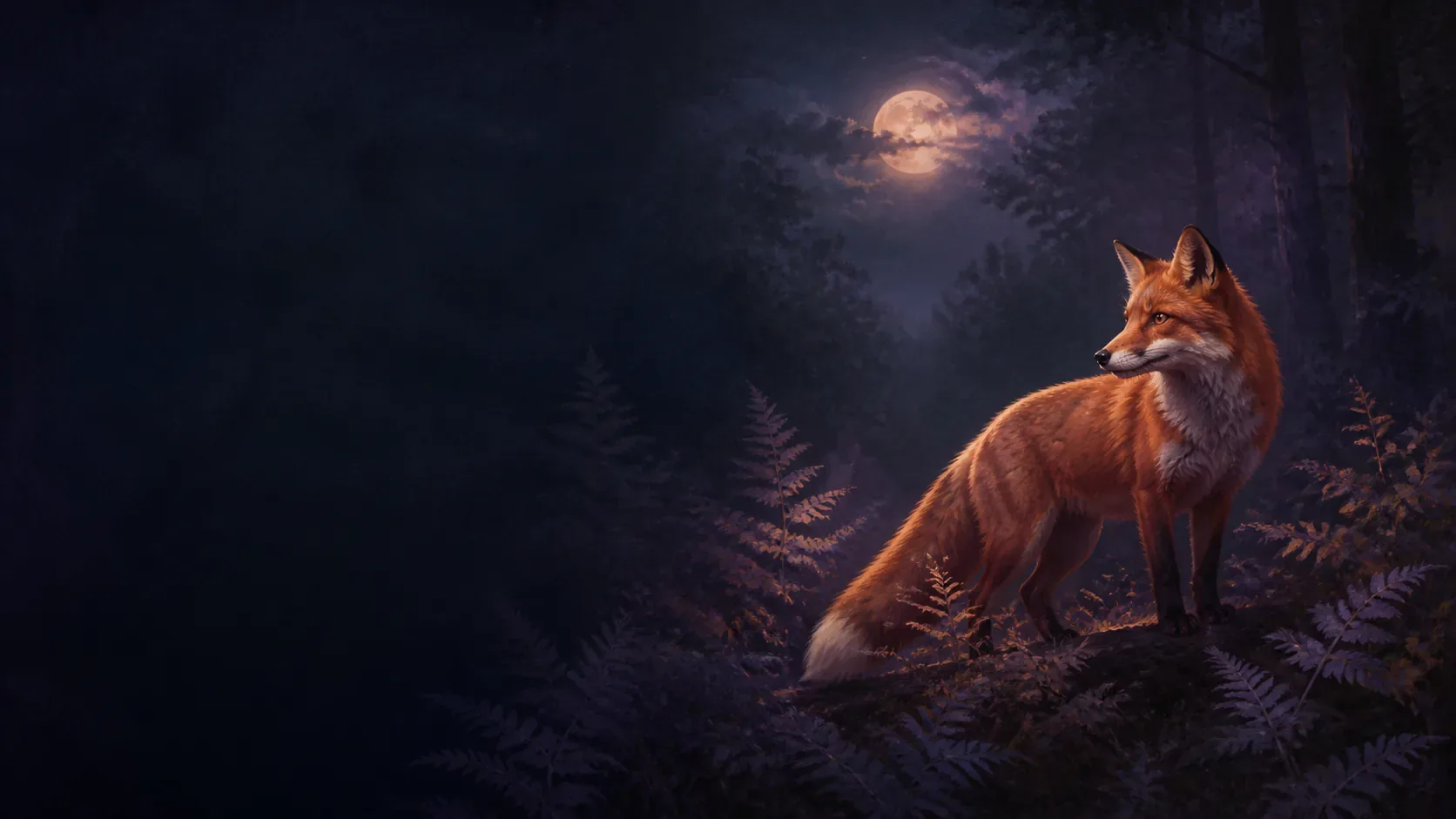
Dream symbol · Animals & observation
What Does Dreaming About a Fox Mean?
Explore a fox dream meaning through species, visibility, observation, distance, route, den, food, condition, color, and your response.
A short answer
A fox dream can focus on careful observation, brief visibility, adaptation, uncertainty, risk, or a problem that keeps moving out of reach. The species, setting, route, behavior, distance, and evidence you had matter more than a fixed idea about cleverness or deception.
What a fox dream can mean
A fox dream can bring observation, brief visibility, adaptation, pursuit, uncertainty, or a shifting boundary into focus. No single meaning applies to every fox. Begin with the animal’s species if you knew it, then note where it appeared, how long you could see it, what it did, and why you paid attention.
Foxes are often treated as symbols of cleverness or deception, but those labels can obscure the actual scene. A fox crossing a field, sleeping in your house, stealing food, watching from cover, or leading you down a road presents a different practical question. Describe the action before deciding what it resembles.
Your reaction gives the encounter direction. Did you feel delighted, suspicious, protective, afraid, curious, or frustrated that the fox kept disappearing? Were you trying to catch it, photograph it, feed it, rescue it, follow it, or make it leave? The same animal can take a different role depending on your goal.
Waking experience may offer the simplest source. A fox seen from a car, a trail-camera image, a local news story, a children’s book, a game, or a familiar urban animal can enter a dream directly. Reflection begins with that personal context, not with a universal symbolic code.
Species setting and visibility make the animal specific
Fox is a broad label. Red foxes, swift foxes, arctic foxes, fennec foxes, and imagined animals differ in habitat, size, color, and behavior. If you recognized a species, ask how. The dream may provide a landscape, large ears, coat color, body shape, or simple certainty without visible evidence.
If you did not know the species, keep the description honest. Was the animal small or large, long-legged or compact, brightly colored or difficult to see? Did it move like a fox you know from life, or did it have features of a dog, cat, wolf, or another animal?
Setting affects visibility. Yellowstone National Park notes that red fox behavior and habitat use differ from nearby coyotes, with research finding more nocturnal activity and a preference for forested habitat. In a dream, darkness, trees, long grass, snow, streets, or artificial light can determine what you see and what remains uncertain.
A fox in a place where it belongs may allow quiet observation. One in a supermarket, bedroom, school, or train makes displacement part of the dream. Ask who else notices it and whether the setting gives the animal a route out.
A fox watching or following you reverses the usual pursuit
A watching fox can make you feel observed by an animal you expected to avoid you. Where is it positioned? It may look from a hedge, roof, doorway, hill, window, or the middle of an open path. Distance and cover show whether it is hidden, protected, or deliberately visible.
Eye contact can feel intimate, challenging, calm, or uncertain. Did the fox look away, approach, copy your movement, or wait for you to act? Avoid treating its gaze as proof that somebody is secretly monitoring you. The scene can explore your experience of attention without identifying a watcher in waking life.
If the fox follows you, notice when you become aware of it. Perhaps you see tracks first, hear movement, glimpse it in reflections, or repeatedly find it at the next location. A follower that keeps its distance differs from one that enters every room.
Your response changes the relationship. You may slow down, test whether it follows, try to lose it, offer food, or begin to rely on its presence. Does following feel protective, predatory, playful, or unexplained? Keep the uncertainty if the dream never answers.
If you turn to confront the fox, record what happens. It may stop, flee, speak, become another animal, or reveal that several foxes were present. The moment can change you from observed subject to active participant.
Following a disappearing animal makes the route important
A fox that repeatedly appears and vanishes turns the route into evidence. Where do you lose sight of it? Cover may include trees, walls, crowds, snow, darkness, drains, tunnels, or an impossible doorway. Each kind of concealment changes how you continue.
Ask why you follow. You may want proof, fear that it is injured, believe it knows a safe route, hope to find a den, or feel unable to leave the mystery alone. The strength of that motive can matter more than whether you catch the animal.
Tracks can offer partial information. Are they clear, mixed with other prints, moving in circles, or ending abruptly? If the tracks change into human footprints or another animal’s marks, note the point of change without assuming it reveals a person’s true identity.
The destination gives the pursuit a purpose. The fox may lead you home, away from danger, toward a trap, to young animals, or nowhere at all. If it disappears at the destination, what remains? An object, person, view, empty den, or closed boundary may become the new focus.
A friendly fox dream depends on evidence and distance
A friendly fox can feel special because the animal’s usual distance seems reduced. Ask what evidence supports friendliness. It may approach slowly, relax nearby, accept food, play, sleep, allow touch, or behave like a known pet. A sudden feeling of trust without visible behavior is also worth noting.
Distance can remain part of a friendly relationship. You may sit near the fox without touching it or walk in the same direction without following. If you try to hold, collar, cage, or bring it home, notice whether it resists. Closeness does not automatically create ownership.
Feeding changes the exchange. Are you helping a hungry animal, gaining its attention, distracting it, or creating dependence? What happens when the food ends? A fox that remains calm differs from one that demands more or leads other animals to you.
A fox inside your house makes access specific. Which room does it choose, and how did it enter? One hiding under furniture creates a rescue or removal problem. One sleeping on a bed may feel domesticated until it tries to leave. Other household members may welcome, fear, ignore, or claim it.
If the fox protects or guides you, identify the task. It may warn you away from a route, find something, distract a threat, or lead you through darkness. The help can matter without turning the fox into a supernatural messenger.
An attack or bite puts safety first
An attacking fox changes observation into immediate danger. Start before contact. Did you corner it, approach a den, take food, try to catch it, or become a target without warning? A defensive response differs from pursuit that appears to have no cause.
Look for signs the dream gave you. The fox may growl, bare teeth, flatten itself, retreat, circle, or act calm until you move. Did another person tell you it was safe or encourage you to touch it? Your access to information may be part of the scene.
Then follow your response. You may back away, block a door, climb, run, protect someone, or try to calm the animal. If the fox bites, note where, how severe it seems, and what happens next. The dream may shift to first aid, escape, concern about the fox, or anger at someone who created the situation.
A fox attack dream does not predict an animal encounter or prove betrayal. The association between foxes and deception comes from learned stories, not a scientific dream rule. If a waking relationship comes to mind, compare observable actions rather than assigning the animal’s behavior to another person’s hidden motives.
If the dream follows a real wildlife encounter, practical safety belongs to current local wildlife guidance. A symbolic reading cannot replace advice about an actual bite, exposure, or animal behaving unusually.
Dens kits and injured animals change your responsibility
A den makes shelter and access central. Did you find the entrance, crawl inside, block it, or discover it beneath a familiar building? A den may be hidden for protection rather than secrecy. Notice whether the fox lives there alone or with young.
Kits change the scale and task. You may watch play from a distance, find one separated from the group, or become responsible for several animals. Did an adult return? A well-intended approach can cross a boundary if the young are already cared for within the dream.
An injured fox places care beside caution. What is wrong, and how do you know? It may limp, be trapped, appear exhausted, or carry an object. Did you have gloves, transport, professional help, or only the wish to intervene? Capacity shapes the scene.
Rescue can succeed, fail, or be refused. A fox may accept help and leave, recover but stay, or escape before you can act. If it becomes dependent on you, ask whether the responsibility feels chosen, imposed, manageable, or larger than expected.
A dead fox can bring sadness, shock, curiosity, or fear. The image does not predict death. A real roadside sighting, news report, story, or worry about wildlife may be a direct source. Focus on what you do after finding it.
Color and cleverness come from expectation as well as observation
Red, silver, white, black, and impossible-colored foxes can draw on species, season, light, clothing, art, games, or memory. Color may affect camouflage and recognition within the scene. It does not predict luck, deception, romance, or money.
A white fox in snow may be difficult to see, while a bright red animal on a city street may be impossible to ignore. Ask whether color helps the fox hide, marks it as an individual, or causes another person to react.
Fables and popular stories often portray foxes as clever, deceptive, charming, or resourceful. Use such an association only when you can connect it with a specific story, phrase, character, or personal expectation. Learned imagery is cultural memory, not a verdict about real foxes or people.
The dream may challenge your expectation. A fox you suspect may behave openly. One you admire may steal, bite, or abandon a route. Compare what you predicted with what the animal actually did.
If you become the fox, notice which quality changes first. Movement, senses, hiding, appetite, size, or other characters’ reactions may matter more than cleverness. The transformation gives you a role to examine, not a secret identity.
Questions to ask after the encounter
Use the prompts that match your scene:
- What kind of fox did I think it was, and what evidence supported that label?
- Where did it first appear, and how long could I see it?
- Was it watching, following, hiding, feeding, playing, attacking, or leading?
- Why did I pursue, trust, avoid, feed, rescue, or remove it?
- Which route, cover, den, doorway, or other boundary mattered?
- Did the fox’s behavior match what I expected from its color or reputation?
- What happened when distance closed?
- Did another person affect my judgment about the animal?
- What recent wildlife sighting, story, image, pet memory, or problem may have supplied it?
- Where in waking life am I working with partial evidence or a situation that keeps changing position?
A useful interpretation keeps observation and assumption separate. It explains why this fox was difficult to see, follow, trust, or help rather than reducing the dream to cleverness.
How waking experiences can enter this kind of dream
Dream research supports continuity between waking concerns, memories, emotions, and dream content. A fox glimpsed during a journey, seen online, read about in a story, or discussed before sleep may provide the image. A current uncertainty may provide the feeling of following something that stays just out of view.
Dreams can combine sources. A red fox from a local road may enter a childhood house, speak with a familiar voice, or lead you through a landscape from a game. Such combinations show how memory can be rearranged. They do not prove the fox carries an outside message.
Research has not established one meaning for foxes, dens, colors, attacks, or disappearing animals. A wildlife researcher, a city resident who sees foxes often, and a reader of fox stories can dream the same scene for different reasons.
If the dream repeats, compare visibility, distance, route, and outcome. Perhaps you stop chasing, the fox stays in view, or a den becomes accessible. A change may help you reflect on your response to uncertainty. It does not predict discovery, betrayal, or success.
Further reading
Sources and context
- Red FoxYellowstone National Park, U.S. National Park Service
- What about dreams? State of the art and open questionsJournal of Sleep Research via PubMed Central
Sources support factual background about dreaming and sleep. They do not validate a fixed symbolic meaning.